Tag

Traditional

Browsing
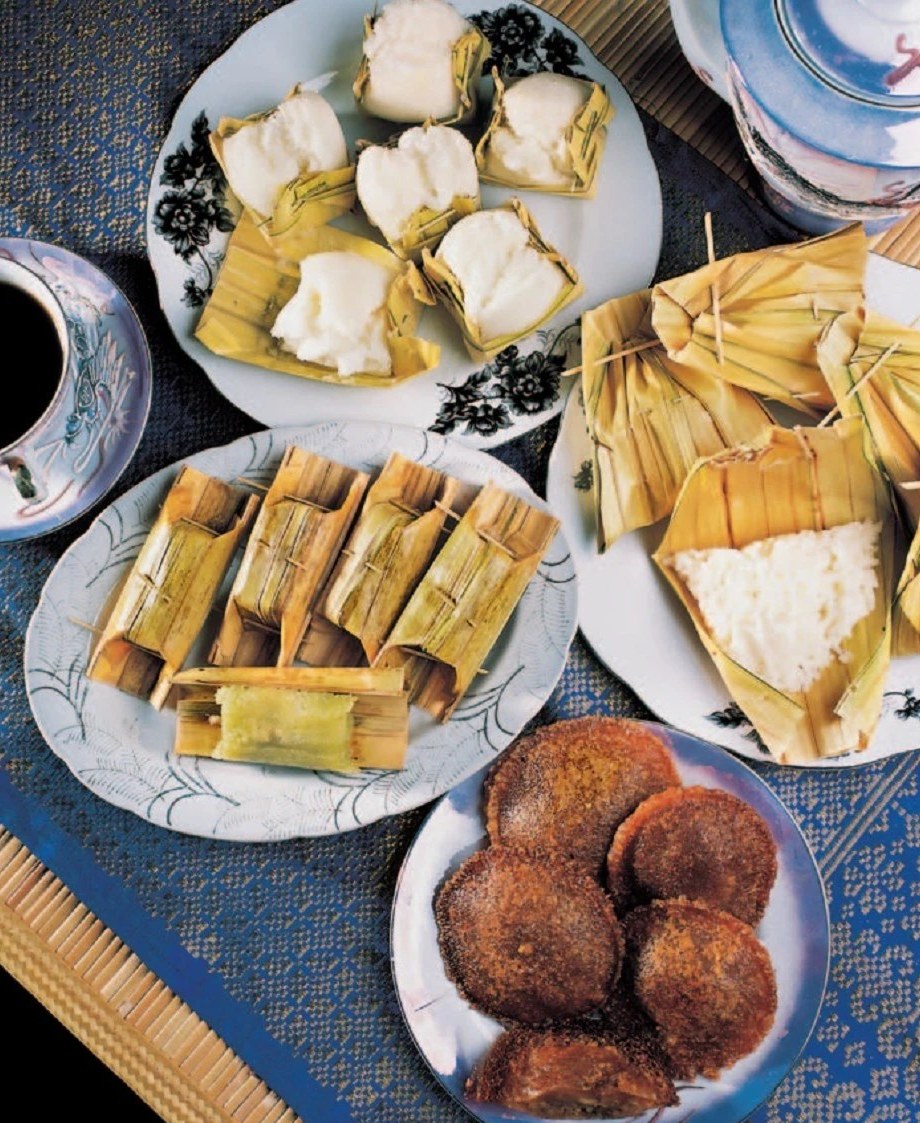
Traditional Brunei specialities served on banana leaves

For those who want to explore local specialities in greater depth, Tamu Kianggeh in the capital of Brunei offers visitors a wide range of flavours — the same market that anchors a morning walk through the water village.

Everyday flavours at Tamu Kianggeh

Most of the food found in this market is everyday food favoured by the local people. Here visitors can enjoy fresh grilled seafood; rice wrapped in banana leaf with all sorts of seasonings such as nasi lemak and nasi katok; banana fritters, sweet potato, corn and many more; and of course desserts such as Malaya cake filled with ground peanuts, condensed milk and sugar. Visitors can also explore a variety of fresh local produce such as vegetables, spices and herbs at this market. It is also a

From the market to the hotel table

unique experience for visitors to meet and interact with local people while enjoying the country’s food culture. Meanwhile, innovative chefs who source quality fresh produce also offer their own distinctive touch to the local cuisine. The special menu at Riwaz, a new luxury Indian restaurant at Radisson Hotel Brunei Darussalam, focuses on conventional fire-cooking techniques, in particular the la broch method, which is a way of grilling, or with the tandoor oven. Traditional dishes such as Murgh Makhani (chicken tikka in

tomato sauce) and Hyderabadi Murgh Dum Biryani (young chicken marinated overnight and cooked together with basmati rice in a covered pot) are delicious with roti nan and pratha.

There is also the dish Pattha ka Gosht (lamb scallops marinated for 48 hours and cooked on hot stones) which uses green chillies and local cashew nuts.

Food will always serve as a bridge between travellers and destinations. Therefore, with the diversity of food in Brunei, the food in Brunei is certainly more delicious and more enjoyable.

Source: MUHIBAH, the Royal Brunei Airlines in-flight magazine, 2019 Mar-Apr, pages 54-55. Printed in Bahasa Melayu and translated into English for this site; text recovered from the scanned page by OCR and lightly corrected.


local. Torch ginger is usually planted in home gardens, where it blooms straight out of the ground, and it is also known as ‘torch ginger’ because it looks like a torch. The varieties of this genus are just as amazing.

Forest ginger is commonly found in the rainforests of Africa and South-East Asia. It is known by many names, such as Porcelain Rose or Torch Lily.

Its striking colour and exotic taste make it a choice in traditional cooking and local dishes.

For example, in the local cooking of Brunei, torch ginger is used as a garnish and also as a flavour enhancer for dishes such as nasi ulam, rice served with local herbs like cassava leaves. Torch ginger delicately perfumes these dishes, and together with other fresh herbs, it helps to make the nasi ulam fragrant. Torch ginger is also used in preparing asam laksa, as an accompaniment with sambal, and it can also be turned into a light sauce with a little soy sauce and vinegar. In cooking, the hard, oily petals are thrown away and only the red, soft interior is used. Torch ginger, given the scientific name Etlingera elatior, has been used for centuries by the people of Borneo. Its shoots and flowers are regarded as vegetables in cooking, or as a seasoning for laksa soup when finely sliced. Its fruit can also be eaten; in fact, the plant can even be used as a natural shampoo!

Its leaves too have antioxidant, antibacterial and tyrosinase-inhibiting properties. The forest ginger plant has similar characteristics. In the country of Brunei Darussalam, there are 77 recorded species of ginger plants.

There are several types, namely Etlingera brevilabrum, which are used

as decorations, while others are used in traditional medical treatment.

One area rich in forest ginger species is Taman Negara Ulu Temburong, where 46 types have been recorded from the survey carried out by Dr Axel Dalberg Poulsen on an expedition in 1991-1992. Of the more than 1,300 species in the ginger family, only a few types of wild ginger are edible. Forest ginger is not yet used in the production of cosmetic products, but scientific studies show encouraging potential because of the presence of active compounds.

Among them is the presence of the active compound phenol, specifically in chlorogenic acid, which is known to support moisture and skin hydration, while at the same time being able to maintain a youthful appearance. To taste edible forest ginger in Brunei, awda can visit any local market or tamu, such as Tamu Kianggeh. Torch ginger flowers are usually sold in bunches, and awda only needs a couple of stalks to add flavour to a dish or salad.

Slice its root finely and awda will be able to enjoy its fragrance, and will understand why torch ginger has for so long been a choice in local cooking…

On 7 April 2016, Brunei Darussalam’s National Forestry Department celebrates its 18 years. The flora chosen for this year’s theme is Etlingera elatior, better known as torch ginger.

Galangal rhizome is used in various Asian cuisines: for example, in Thailand and Laos it is used in tom yum cooking. Although the taste of ginger is a little like galangal, most cooks who use both of these rhizomes will not substitute one flavour for the other.

Source: MUHIBAH, the Royal Brunei Airlines in-flight magazine, 2016 May-Jun, pages 53-55. Printed in Bahasa Melayu and translated into English for this site; text recovered from the scanned page by OCR and lightly corrected.
not only will you be allowed to visit the beautiful, spacious gardens within the palace grounds, but you will even have the chance to step into the magnificent, luxurious hall which is the official residence of His Majesty Paduka Seri Baginda Sultan Haji Hassanal Bolkiah Mu’izzaddin Waddaulah, Sultan and Yang Di-Pertuan of Brunei Darussalam. However, the memories imprinted are not confined only to the beauty of the palace’s interior decorations or the delicious, luxurious food served. On the contrary, the memory that is least likely to be forgotten is the opportunity to meet face to face and to bring forth feelings of gratitude and joy at being able to meet His Majesty and other members of the Royal Family at closer quarters. The tradition of ‘open house’ is practised in the State of Brunei Darussalam as well as in the neighbouring country, Malaysia. It is a tradition of receiving and being cordial with all levels of society, usually when welcoming some celebration, without requiring any official invitation. What distinguishes and is unique about the Istana Nurul Iman Open House and the Curds and Sweet Distribution Session is that these sessions are the only open house in the world organised by a country’s top leader at the official residence for three consecutive days, welcoming arrivals from all levels of society. Based on the open house held previously, it is estimated that His Majesty and the members of the Royal Family also stood for a period of five hours to exchange greetings and be cordial with everyone present.

It is estimated that His Majesty together with members of the Royal Family have greeted and met more than 100,000 visitors while this celebration was under way!

Source: MUHIBAH, the Royal Brunei Airlines in-flight magazine, 2014 Jul-Aug, pages 76-76. Printed in Bahasa Melayu and translated into English for this site; text recovered from the scanned page by OCR and lightly corrected.

As the wedding date draws near, the couple-to-be will undergo the berbedak mandi ceremony. Close family members will clean the bodies of the groom and the bride with traditional bathing. This ceremony is always enjoyable and takes place in a cheerful atmosphere, in which the whole family can rejoice in celebrating the wedding that is about to take place. The akad nikah ceremony is an

important ceremony in which

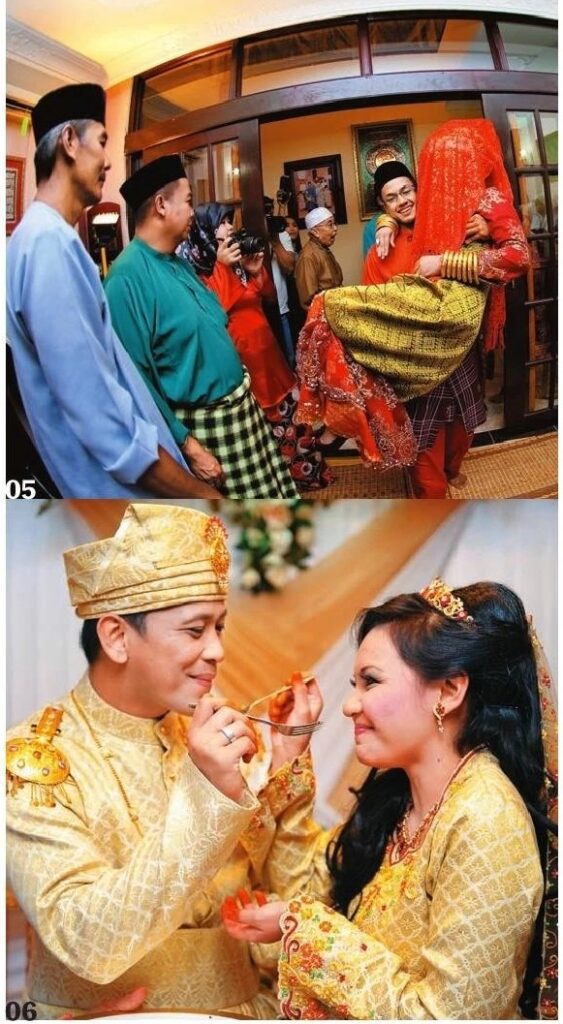
the wedding between the man and the woman is solemnised by a kadi. Only at that moment are the couple confirmed as husband and wife. During the malam berbedak ceremony, relatives and close friends are invited to give their blessing using rice flour and scented oil at the respective homes of the groom and the bride. The couple are fully dressed in traditional Brunei woven cloth which symbolises the rich heritage of the State of Brunei Darussalam. A fragrant scatter of flowers made from pandan leaves, flower petals and perfume is also sprinkled over the palms of the bride’s hands as a sign of blessing.

The malam berinai or berpacar is attended by close family, in which the bride will be dressed similarly to the night of the berbedak. The couple will sit on the pelamin facing family members, who will take turns dusting tawar flour with a pinch of lime over their palms. Some wedding celebrations will hold this ceremony on the same night as the malam berbedak, however there are also families who prefer to hold it on a different night.

Source: MUHIBAH, the Royal Brunei Airlines in-flight magazine, 2014 Mar-Apr, pages 52-52. Printed in Bahasa Melayu and translated into English for this site; text recovered from the scanned page by OCR and lightly corrected.

A glittering Malay-Brunei traditional wedding is an experience that should not be missed.

Text KIM LOW Images WAHYUDI BORHAN

Wedding customs of the Sultanate

As a historic Sultanate, the customs, resam and traditions of the people of Brunei today. Among the ceremonies in which the unique heritage of the State of Brunei Darussalam is still clearly visible are traditional wedding ceremonies. The celebration consists of several nights of gift-giving and three days of a Malay wedding, a glittering tradition up to this day.

The celebration enters its stage to obtain the blessing of the closest family

is rice flour on the night of the berbedak

The foot-washing ceremony is one of the wedding customs from Tutong District, a living piece of Brunei’s wider Islamic and Malay heritage.

Mengagai and the betrothal

Mengagai or berjarum-jarum is the first step in the journey of binding the couple as a sign of interest from the man’s side. It originates from ancient culture, in which men and women did not meet openly. Instead the groom-to-be would send a representative, usually his own parents, to enquire whether the girl of his choice was still unattached. However in modern times, this ceremony is used as the starting step for the wedding ceremony, in which the groom will meet his future parents-in-law. Both parties will discuss the date for sending an official delegation to formalise the betrothal of the couple-to-be.

The next ceremony is when the groom sends an official delegation to the bride’s house to deliver the token of betrothal. This is followed by the sending of gifts or hantaran pertunangan, also known as menghantar berian, in which the groom’s family will bring along all the requests from the woman’s side during the betrothal ceremony. Usually the groom will also send gifts

Source: MUHIBAH, the Royal Brunei Airlines in-flight magazine, 2014 Mar-Apr, pages 50-51. Printed in Bahasa Melayu and translated into English for this site; text recovered from the scanned page by OCR and lightly corrected.

“IT IS EXCITING, MEMORABLE, TRULY ENCHANTING,” THE HONOURABLE DANIEL SHIELDS, UNITED STATES AMBASSADOR TO BRUNEI.

The finishing line of this boat race is usually at the Brunei Royal Customs and Excise Wharf in Bandar Seri Begawan, formerly known as Brunei Week. The race categories include single sculling, doubles, teams of 20 participants and teams of 30 participants. The more rowers there are in one team, the further the race distance.

boat racing, and he often played the role of a handicapper which is similar to the task of a team captain. Because the race is held in the month of September, the name of this festival is no longer suitable and Berjanawari is not known. Since then, the name of this boat racing festival has been known as ‘regata’

In the 1950s, during the reign of the late Al-Marhum Sultan Haji Omar ‘Ali Saifuddien Sa’adul Khairi Waddien the boat race was held in the month of September to celebrate His Majesty’s birthday. The late Sultan was a keen

This regatta event was quite popular from the 1950s to the 1970s. However, because of reasons which could not be avoided, in the end it could no longer be organised.

In 2012, with warm welcome from citizens throughout the country, His Majesty

Seri Baginda Sultan Haji Hassanal Bolkiah Mu’izzaddin Waddaulah, Sultan and Yang Di-Pertuan Negara Brunei Darussalam, was graciously pleased to decree that the celebration of this traditional event so dearly loved by the people of Brunei would be held again.

The celebration of this racing festival was given the new name ‘Brunei Darussalam Regata

The 2013 racing edition saw the participation of teams from Australia, Indonesia, Malaysia and the United States. The race categories were divided into 12 categories, namely traditional boat racing, four powerboat races, and two for passenger boat racing and jet ski each-

Source: MUHIBAH, the Royal Brunei Airlines in-flight magazine, 2014 Jan-Feb, pages 54-54. Printed in Bahasa Melayu and translated into English for this site; text recovered from the scanned page by OCR and lightly corrected.

REGATA BRUNEI DARUSSALAM A boat racing heritage restored and given new life.

Text KIM LOW Images BRUNEI TIMES

The Brunei River used to run through Brunei Darussalam, this river was indeed always busy with various activities. Today, passenger boats are seen busy carrying the residents of Kampong Ayer, but formerly the busy activities

The late Al-Marhum Sultan Haji Omar ‘Al Saifuddien Khairi Waddien was a keen fan of boat racing. Brunei River Boat Races in the 1930s-1950s

This river was also at one time busy with one other kind of activity. The residents of Kampong Ayer used to organise

the berjanawari event, a highly unusual boat racing festival. The word ‘berjanawari’ originally comes from the name of the month of January – ‘berjanuari’ – because at that time that month was considered a month full of celebration. In time, this name became a synonym with the festival

of dragon boat racing which was held for five

days on that river. According to some sources, that race was originally first introduced by the

British as a way of celebrating

the new year in this Sultanate

passenger boats crammed with passengers, some of them decorated with unique inventions of their own to add further cheer to this racing festival. Citizens from all over Brunei came in droves to visit the festival area, boarding their passenger boats and also their own boats, not only as spectators but also as participants.

Because there are among them those who came from other districts, it was also usual for certain participants to bring their families along to that event. Some participants took part in the race with their own boats, to compete against rival teams from other districts. There are others who are paid or sponsored to support a local team.

Source: MUHIBAH, the Royal Brunei Airlines in-flight magazine, 2014 Jan-Feb, pages 52-53. Printed in Bahasa Melayu and translated into English for this site; text recovered from the scanned page by OCR and lightly corrected.

PHO What it is: Slippery rice noodles dancing in warm, deeply savoury broth.

This beloved rice noodle dish is complete meal in itself. Often taken over breakfast or lunch, good pho broth is the key to delicious meal.

Traditionalists will say good broth is clear and not muddy, wafting with the fragrance of beef, star anise and ginger. Finish the dish off with generous

squeeze of lime and copious amounts of basil and mint.

Where to find it: Vietnam.

HAINANESE CHICKEN RICE What it is: dish that has been adapted from early Chinese immigrants originally from Hainan can only mean one thing it’s must-try! The centerpiece of this meal is the fragrant ginger and garlic that lend its simple flavours to create compelling dish. The rice is cooked with chicken fat and stock then served with steamed or boiled chicken and soup on the side. Families have their own secret recipes for the condiments, the chilli, ginger and soy sauces, that round up the flavours of the dish.

Where to find it: Malaysia, Singapore.

Source: MUHIBAH, the Royal Brunei Airlines in-flight magazine, 2017 Sep-Oct, pages 33-34. Text recovered from the scanned page by OCR and lightly corrected; spelling may differ from the printed edition.

Now til HONG KONG SUDO REIKO: MAKING NUNO TEXTILES Taking place at CHAT in Tsuen Wan, Sudo Reiko: Making NUNO Textiles showcases textile designer Sudo Reiko’s innovation in textiles, integrating traditional craft into textile making with new materials such as washi paper and techniques like needle punching. Her ethical yet radical textiles have been recognised globally with regards to preservation and revitalisation of traditional craftsmanship and fabric recycle. www.milléchat.org

CHINA JEAN NOUVEL, IN MY HEAD, IN MY EYE… BELONGING The Power Station of Art, Shanghai, will be presenting the works of French architect Jean Nouvel. Going for an unconventional route, Nouvel will transform the exhibition room into theatre filled with light and shadow for his exhibition titled Jean Nouvel, in my head, in my eye… belonging… Debuting three-and-ahalf-hour film as well as six works of art based on his architecture, visitors will be able to immerse themselves in architectural wonders. powerstationofart.com

Nouvel, Jean Ateliers UNITED KINGDOM CIRQUE DU SOLEILS LUZIA Cirque du Soleil will be bringing its dazzling luminous spe le LUZIA to Royal Albert Hall. Taking place in an imaginary Mexico, the name of the show is inspired by waking dream, where light (“luz” in Spanish) quenches the spirit and rain LUZIA cleverly brings to the stage multiple places, faces and sounds of Mexico taken from both tradition and modernity.

Source: MUHIBAH, the Royal Brunei Airlines in-flight magazine, 2020 Jan-Feb, pages 60-61. Text recovered from the scanned page by OCR and lightly corrected; spelling may differ from the printed edition.

calendar. This year is the Year of the to usher in the new year would have

(ding up to the festivities.

le eve of Lunar New Year for

the most important Customs of the celebration, the reunion dinner, where people travel from all over to while f@stering close ties. For the next 15 days, the festival is enjoyed with family and friends, observing traditions that involve lion dancessfood, rituals and more.

Festive parades to traditional customs, Chinese communities in countries all over usher in the Year of the Rat this January.

SAM BAKARR vee”

Also the Spring Festival, Chinese New Year is the shops are set up itive items and Mapy other thingsit6 prepal rthe celebration. om make their way to their hometowns to celebrate with their family, and with China’s huge population, the travel has often been called the largest annual human migration in the entire world. Once with their loved ones, the celebration begins with reunion dinner the night before. The next few days, the festival is observed with several traditions and customs such as wearing red for good luck, praying to gods and ancestors for blessings, refraining from cleaning of houses to avoid sweeping the good luck away, and children receiving lucky in red envelopes. Royal Brunei Airlines flies Belling 4x weekly and Shanghai 3x weekly.

Source: MUHIBAH, the Royal Brunei Airlines in-flight magazine, 2020 Jan-Feb, pages 16-19. Text recovered from the scanned page by OCR and lightly corrected; spelling may differ from the printed edition.