
Princess ofthe Getting to know Brunei’s Hoya.
GRACE CHOY DEPARTMENT OF FORESTRY, BRUNE! DARUSSALAM
Back in 2011, new species of Hoya was discovered in Tutong, Brunei Darussalam.
Ho… what? Well, unless you are plant collector, you will know that the Hoya, also known as wax flower, is much prized and loved plant
among home gardeners for its unusual foliage and vast array of flower form.
Plus, it’s one of the easiest plants to care for.
The discovery of new Brunei species is significant because Hoya’’s diversity on the island of Borneo is difficult to estimate, as many areas still need to be explored. However, despite its diminutive size,
Brunei is very rich in the Hoya species. ee In comparison, Peninsular Malaysia, whose flora has been much more extensively investigated, has only 27 recorded species.
The new Brunei species, Hoya wongii, could not have come at better time. It is trending among plant growers, and while its botanical names can be tongue twisters such as Hoya purpureofusca (reddish brown flower) or Hoya pubicalyx (fuzzy calyx) its caretaking is far from complicated.
Hoyas are quite hardy. They grow well in tropical temperatures, thrive in 50 percent humidity, and have all the colours of the rainbow except blue and black.
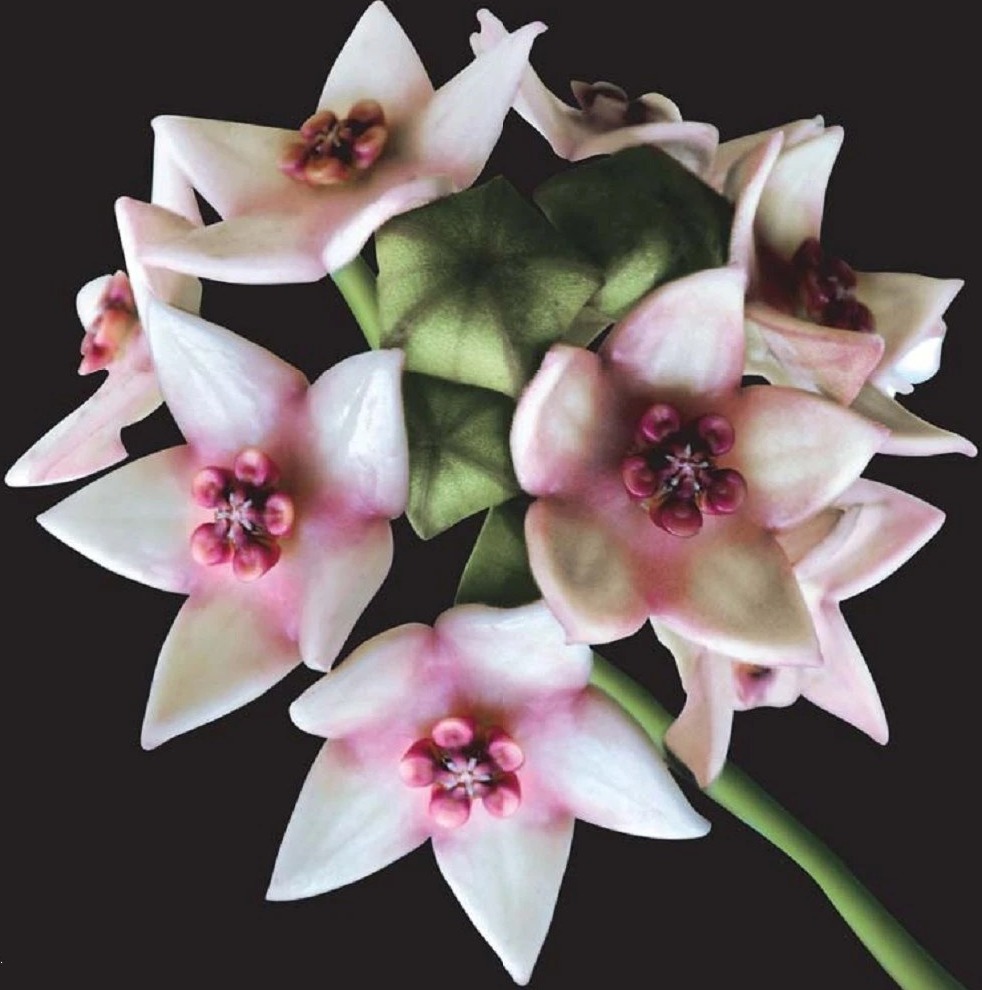
There are oranges, greens, pinks, yellows and reds, while some even come multi-coloured. They easily grow indoors, under fluorescent or filtered light, and yet when it blooms, Hoyas give you the most stunning
image nature has ever captured.
Hoya coronaria
Even Gwyneth Paltrow has jumped on the Hoya bandwagon. branded beauty oils with Hoya as its main ingredient. Goop is the lifestyle blog she founded in 2008. may be the first in the skincare industry to use the flower’s super-rare oil in beauty line. According to the website, phytosterols and terpenes, organic compounds that are believed to help the Hoya plant heal and grow, work on skin the same way and can
also effectively help prevent breakouts.
Elsewhere, the Hoyais also valued for its medicinal properties among various cultures. Chinese medicine uses the Hoya as an anti-inflammatory. Its leaves have been used on wounds and burns, and the entire plant has been used to treat skin irritation and insect bites. Some studies have even shown the Hoya to be natural air purifier. No matter how you view the Hoya, two things are certain. Hoyas make excellent houseplants for their attractive foliage and, you’ll love its
strongly scented flowers.
Buds of the Hoya coronaria Blume.
Source: MUHIBAH, the Royal Brunei Airlines in-flight magazine, 2015 Mar-Apr, pages 46-49. Text recovered from the scanned page by OCR and lightly corrected; spelling may differ from the printed edition.
