
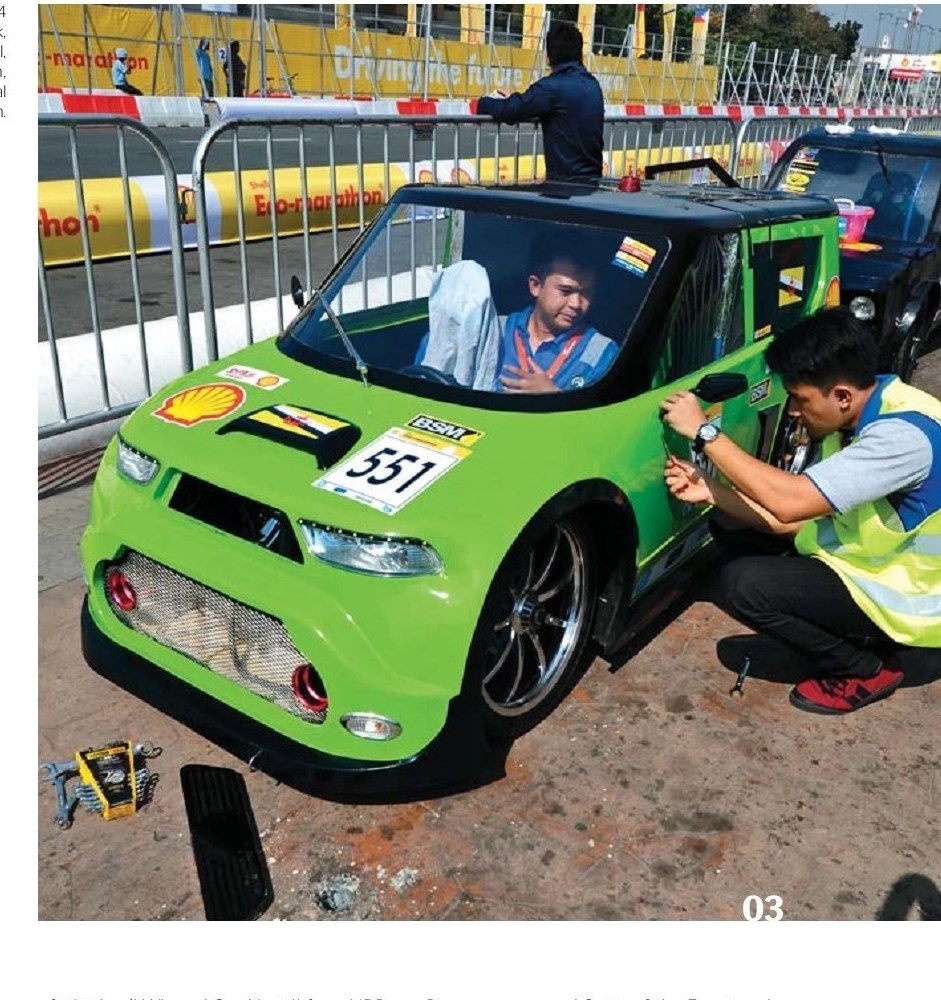
Panglima powered by FAME (Fatty Acid Methyl Ester), from the Mechanical Training Centre. SVSB Automaxx from Sekolah Vokasional Sultan Bolkiah at the Technical Inspection station.
The first challenge for the Brunei Teams was to ensure that their vehicles passed technical inspection before being allowed to enter the circuit. Every vehicle is fitted with a chip and must go through a series of inspection stations. These include the brake inspection station, the dimension and vehicle measurement inspection, and the vehicle weight inspection. Prototype vehicles may not exceed a weight of 140 kg, while for Urban Concept vehicles the maximum weight limit is set at 205 kg. Inspection also ensures that the driver can see 180 degrees ahead, which is very important when out on the circuit, and that the driver can get out of their vehicle within 10 seconds if any emergency occurs. At each station, an inspecting officer uses an electronic pad to scan the chip on the vehicle and records whether it passes or fails at each stage of the inspection. All teams need to work hard to solve whatever problems arise before returning to the circuit. Among the notable points about this year’s race is the participation of the Brunei women’s team. The PLM Alpha Team enters the race with an electric Prototype vehicle powered by a
battery, with a black and yellow capsule that resembles a wheeled rhinoceros beetle. The team that had to go through the most obstacles was the Bruda-Mech Team from SVSB when it wanted to pass technical inspection. In the end, however, all five Brunei entries were given the green light to join the race. After all the cars passed technical inspection, the drivers began racing around the 1.2 km circuit, monitored by 16 closed-circuit cameras and a
safety team led by former F3 series champion, Pepon Marave. Drivers are not allowed to cut other vehicles on a corner or to use the horn when overtaking in other areas of the circuit. Those who break the rules are given a warning and may be disqualified from the race. Drivers are also given only 30 seconds to restart their vehicles if they stall, before one of the 26 race marshals pulls their vehicles out on safety grounds.
Drivers will attempt to complete 10 laps of the circuit before race officials measure the amount of fuel used and at the same time determine the kWj or kWL record.
Only two Brunei Teams managed a full run on the circuit, namely the Alpha women’s team from PLM with a best record of 52.7 km/kWj and the GenNext II team from UBD with a record of 112.1 km/kWj, good enough to take 10th place in the race.
Shell Eco-Marathon Asia 2014 saw 24 On-Track Awards with prize money of US$2,000 and US$1,000 respectively for the winner and runner-up in both the Prototype and Urban Concept categories. The Indonesia Team and the Thailand Team emerged as the big winners of this year’s race with four and three championship titles respectively.
At the same time, Shell also presented the side awards for the categories of Communication, Vehicle Design, Technical Innovation, Safety, Durability and Competitive Spirit, as well as the Shell Helix Tribology Award.
This special Shell Helix Tribology Award
is given in recognition of student teams who successfully use the principles of lubrication engineering in their design to increase the effectiveness of fuel savings in their vehicles. Although the Brunei Teams did not emerge as champions, their performance this time shows high potential and ability in terms of team spirit, communication and camaraderie, while at the same time bringing pride to the country.
The Brunei Teams were sponsored by Syarikat Minyak Brunei Shell Sdn Bhd (BSP) and Syarikat Pemasaran Brunei Shell Sdn Bhd (BSM).
Source: MUHIBAH, the Royal Brunei Airlines in-flight magazine, 2014 Sep-Oct, pages 54-55. Printed in Bahasa Melayu and translated into English for this site; text recovered from the scanned page by OCR and lightly corrected.
